Most food trucks depend on propane every day. It powers griddles, fryers, charbroilers, ranges, steam tables, and many other appliances that make a commercial mobile kitchen possible.
Choosing the right propane tank is about much more than how much fuel it holds. Tank size affects runtime, available storage space, lifting weight, mounting requirements, inspection requirements, and even which type of protective cage will fit your truck.
Whether you're building your first concession trailer, replacing an existing propane system, or trying to decide between removable cylinders and a permanently mounted tank, understanding your options before you buy can save time, money, and frustration.
This guide explains:
- The differences between 20 lb, 30 lb, 40 lb, 60 lb, and 100 lb propane cylinders
- How long different tank sizes typically last
- How to estimate propane usage based on your equipment
- The differences between DOT cylinders and ASME tanks
- Food truck propane regulations and inspection requirements
- How to measure for a propane tank cage
- Common mistakes that lead to installation problems
Whenever local regulations are discussed, remember that many jurisdictions adopt national standards differently. Always verify requirements with your local authority having jurisdiction (AHJ) before purchasing equipment or modifying your truck.
1. Food Truck Propane Tank Sizes at a Glance
For most food truck owners, these are the common cylinder sizes you'll encounter.
| Tank Size | Typical Diameter | Typical Height | Typical Filled Weight | Common Uses |
|---|---|---|---|---|
| 20 lb | About 12.0 to 12.3 in | About 17 to 18 in | About 37 lb | Coffee trailers, light-duty concession stands, small cooking loads |
| 30 lb | About 12.2 to 12.3 in | About 23 to 24 in | About 54 lb | Small concession trailers and moderate propane demand |
| 40 lb | About 12.2 to 12.3 in | About 29 in | About 69 to 74 lb | Many full-service food trucks |
| 60 lb | About 12.0 to 12.5 in | About 43 to 45 in | About 106 to 109 lb | Higher-demand trucks needing more runtime |
| 100 lb | About 14.7 to 14.9 in | About 47.5 to 49 in | About 168 to 170 lb | High-volume operations and longer service days |
These dimensions represent common manufacturer ranges rather than one universal standard. Actual measurements vary by manufacturer and model.
2. Choosing the Right Propane Tank Size
One of the most common questions food truck owners ask is:
"What size propane tank do I actually need?"
The answer depends on five practical considerations.
1. Your appliance load
A truck running a single coffee brewer and a small range has very different fuel needs than one operating multiple fryers, a griddle, and a charbroiler all day.
As your total BTU demand increases, larger cylinders become more practical because they provide longer runtime between refills. The research also notes that systems with a total appliance input of 100,000 BTU/hr or more require additional attention to regulator design under NFPA 58.
2. Available mounting space
Space is limited on every food truck.
A larger tank may provide more runtime, but it also requires:
- more mounting space
- a larger protective cage
- additional clearance around valves and regulators
- stronger structural mounting
Many operators discover that their available mounting location determines the largest cylinder they can realistically use.
3. How often you're willing to refill
Larger cylinders reduce refill frequency.
Smaller cylinders are easier to handle but require more frequent trips for propane.
For some operators, convenience outweighs runtime.
For others, especially trucks operating long festivals or multi-day events, maximizing runtime is more important.
4. Filled weight
Tank weight increases quickly.
| Size | Typical Filled Weight |
|---|---|
| 20 lb | About 37 lb |
| 30 lb | About 54 lb |
| 40 lb | About 69 to 74 lb |
| 60 lb | About 106 to 109 lb |
| 100 lb | About 168 to 170 lb |
That additional weight affects:
- mounting hardware
- cage design
- lifting
- vehicle payload
A 100 lb cylinder weighs more than twice as much as a 40 lb cylinder when full.
5. Local inspection requirements
National standards provide a baseline, but local enforcement varies.
Some jurisdictions limit total propane capacity.
Others specify cylinder counts, mounting methods, or additional inspection requirements.
Always verify local requirements before purchasing equipment or fabricating mounting systems.
Which Tank Size Is Best?
There isn't a single "best" propane tank for every food truck.
Instead, each size fits a different type of operation.
20 lb cylinders
These are the smallest commonly used cylinders discussed in this guide.
Advantages include:
- easiest to lift
- widely available
- easy exchange network
- compact footprint
Their biggest disadvantage is runtime.
Operators with larger cooking loads often find themselves replacing or refilling these cylinders frequently.
30 lb cylinders
Thirty-pound cylinders provide noticeably more runtime while maintaining nearly the same diameter as a 20 lb cylinder.
That makes them attractive when vertical space is available but width is limited.
They're commonly used on:
- concession trailers
- coffee trailers
- moderate-duty mobile kitchens
Unlike 20 lb cylinders, however, exchange programs are much less common, so refilling is usually the practical option.
40 lb cylinders
Many food truck suppliers identify 40 lb cylinders as the practical middle ground for full-service trucks.
They retain the familiar 12-inch diameter while offering substantially longer runtime than 20 lb or 30 lb cylinders.
For many operators, they provide a good balance between:
- runtime
- portability
- weight
- mounting space
If you're building a standard food truck with a moderate cooking load, this is often one of the first sizes worth considering.
3. Propane Tank Dimensions: Why Measuring Matters
When shopping for propane tanks or a propane tank cage, many people assume that all cylinders with the same advertised size have identical dimensions.
They don't.
A 40 lb cylinder from one manufacturer may be slightly taller or wider than a 40 lb cylinder from another. The differences are usually small, but they're large enough to create problems if a cage or mounting location was built with almost no clearance. That's why it's always better to measure your actual cylinder than rely on a specification you found online.
For food truck builders and fabricators, this is especially important because the cage has to accommodate more than just the cylinder body. The collar, foot ring, valve, regulator connection, and hose routing all require additional space.
Typical Dimensions by Tank Size
The table below summarizes the typical dimensional ranges found across major manufacturers.
| Nominal Size | Typical Height | Typical Diameter | Notes |
|---|---|---|---|
| 20 lb | 17.2 to 18.0 in | 12.0 to 12.3 in | Small variations between manufacturers |
| 30 lb | 23.4 to 23.7 in | 12.2 to 12.3 in | Similar diameter to 20 lb cylinders |
| 40 lb | 29.3 to 29.4 in | 12.2 to 12.3 in | Much taller without becoming wider |
| 60 lb | 43.1 to 44.5 in | 12.0 to 12.5 in | Greater variation between manufacturers |
| 100 lb | 47.5 to 49.0 in | 14.7 to 14.9 in | Larger diameter and several valve configurations available |
These measurements represent typical manufacturer specifications rather than a universal standard. Always verify the dimensions of the cylinder you actually own.
The 60 lb Cylinder Is Less Standardized Than Most People Realize
Most propane size guides completely skip the 60 lb cylinder.
That's unfortunate because it's one of the most interesting sizes for commercial food trucks.
Unlike 20 lb, 30 lb, and 40 lb cylinders, 60 lb cylinders show noticeably more variation between manufacturers. Overall height, diameter, empty weight, and valve configuration can all differ depending on who built the cylinder.
If you're designing a custom cage or replacing an existing cylinder with another brand, it's worth measuring before assuming it'll fit.
100 lb Cylinders Also Vary More Than Many Buyers Expect
The phrase "100 lb propane tank" describes a capacity, not a single physical design.
Manufacturers offer different versions with varying:
- overall height
- collar design
- valve arrangement
- multi-valve configurations
- service connections
Some are intended primarily for vapor service, while others include additional valve arrangements for different applications. That's another reason a custom cage should be designed around the actual cylinder being used whenever possible.
How to Measure Your Propane Tank
Fortunately, measuring a propane cylinder is simple.
For most food truck applications, only two measurements are needed:
- overall height
- maximum diameter
Measure the diameter across the widest part of the cylinder body.
Measure the height from the bottom of the foot ring to the highest point of the protective collar.
These two measurements will identify the correct size in most situations.
Don't Forget Service Clearance
Even if the cylinder physically fits inside a cage, it still has to be usable.
A properly designed installation leaves room for:
- opening and closing the service valve
- connecting the regulator
- routing the pigtail hose
- removing and replacing the cylinder
- performing inspections
The research emphasizes that shutoff valves must remain accessible without tools. A cage that blocks valve access may create compliance problems even if the cylinder technically fits.
Why Propane Tank Size Isn't the Same as Runtime
One of the biggest misconceptions among new food truck owners is that doubling the size of the propane tank automatically doubles how long the kitchen can operate.
It's not quite that simple.
Runtime depends on several factors working together:
- total propane capacity
- total appliance BTU demand
- outdoor temperature
- how often appliances cycle on and off
- the cylinder's ability to vaporize propane fast enough
A larger cylinder generally provides longer runtime, but it also has to supply enough vapor to meet the demand of every appliance that's operating.
This is why two food trucks using the same size cylinder can see very different runtimes. One truck may only be running a coffee brewer and a small range, while another is operating multiple fryers, a griddle, and a charbroiler simultaneously.
In the next section, we'll look at how to estimate propane runtime using appliance BTU ratings, why real-world runtime often differs from simple calculations, and how vaporization affects high-demand food truck kitchens.
4. How Long Does Propane Last on a Food Truck?
One of the first questions new food truck owners ask is:
"How long will this tank last?"
Unfortunately, there's no single answer.
A coffee trailer that only uses propane for hot water may run for days on a single cylinder. A busy food truck running multiple fryers, a griddle, and a charbroiler can burn through propane much faster.
The good news is that estimating runtime is straightforward once you know two things:
- How much propane the cylinder holds
- The total BTU input of your appliances
- The Basic Runtime Formula
According to the Propane Education & Research Council (PERC), propane contains approximately 21,548 BTUs per pound, or about 91,502 BTUs per gallon. Using that value, runtime can be estimated with this formula:
This assumes every appliance is running continuously at full input, which rarely happens in the real world. Still, it's a useful starting point for comparing tank sizes.
Example Runtime Calculation
Imagine a food truck with:
- 24-inch griddle: 60,000 BTU/hr
- Fryer: 70,000 BTU/hr
- Total appliance load: 130,000 BTU/hr
Using a 40 lb propane cylinder:
40 × 21,548 = 861,920 BTUs available
861,920 ÷ 130,000
≈ 6.6 hours
Again, that's continuous full-fire operation.
In actual service, thermostats cycle burners on and off, so many trucks operate longer than the calculated value.
Estimated Runtime by Tank Size
The table below uses continuous-fire calculations based on representative commercial appliance inputs.
| Tank Size | 60k BTU Griddle | 70k BTU Fryer | 80k BTU Charbroiler | 145k BTU Light Cook Line | 230k BTU Heavy Cook Line |
|---|---|---|---|---|---|
| 20 lb | 7.2 hr | 6.2 hr | 5.4 hr | 3.0 hr | 1.9 hr |
| 30 lb | 10.8 hr | 9.2 hr | 8.1 hr | 4.5 hr | 2.8 hr |
| 40 lb | 14.4 hr | 12.3 hr | 10.8 hr | 5.9 hr | 3.8 hr |
| 60 lb | 21.6 hr | 18.5 hr | 16.2 hr | 8.9 hr | 5.6 hr |
| 100 lb | 35.9 hr | 30.8 hr | 26.9 hr | 14.9 hr | 9.4 hr |
These values are intended for comparison. Actual runtime depends on appliance cycling, menu, ambient temperature, and several other variables.
Why Real-World Runtime Is Different
Many online calculators stop after dividing available BTUs by appliance BTUs.
That's useful, but it's only part of the story.
Real-world runtime depends on factors such as:
- burner duty cycle
- outside temperature
- liquid level inside the cylinder
- simultaneous appliance use
- regulator design
- the cylinder's ability to produce vapor
The research emphasizes that propane vaporization depends on:
- ambient temperature
- wetted surface area
- remaining liquid level
- humidity
- installation conditions
That's why a tank that performs well on a warm summer afternoon may struggle during a cold morning service.
Understanding Vaporization
Propane is stored inside the cylinder as a liquid.
Your appliances don't burn liquid propane.
They burn propane vapor.
Every time you open a burner, some of the liquid inside the cylinder boils into vapor.
That phase change requires heat.
The cylinder absorbs that heat from the surrounding air.
If propane is being used faster than the cylinder can absorb heat, the cylinder cools rapidly.
Eventually, frost may begin forming on the outside.
This doesn't necessarily mean there's something wrong with the tank.
It's often a sign that the cylinder is working hard to keep up with demand.
High-BTU Food Trucks Need More Than Bigger Tanks
A larger cylinder doesn't just increase runtime.
It also provides more liquid surface area for vaporization.
However, once total appliance demand becomes high enough, simply choosing a bigger cylinder may not be enough.
The research notes that systems with a total appliance input of 100,000 BTU/hr or greater require additional regulator considerations under NFPA 58, including two-stage or equivalent regulator systems.
That means as your kitchen grows, you're designing an entire propane system, not simply choosing a larger tank.
Which Tank Size Fits Different Types of Food Trucks?
Although every operation is different, the research suggests some general patterns.
Coffee trailers and light-duty concession stands
These operations often have relatively modest propane demand.
Depending on the equipment, 20 lb or 30 lb cylinders may provide adequate runtime while keeping weight and space requirements low.
Standard food trucks
Many supplier resources identify 40 lb cylinders as a practical middle ground.
They provide substantially longer runtime than 20 lb cylinders while maintaining a similar diameter, making them easier to package into compact truck layouts.
Higher-demand operations
Food trucks with larger cooking lines often benefit from 60 lb or 100 lb cylinders.
The additional capacity reduces refill frequency, but it also increases weight and requires stronger mounting systems.
Because 60 lb cylinders vary more between manufacturers, measuring the actual cylinder before building or buying a cage becomes even more important.
Permanently mounted systems
Some high-volume food trucks move away from removable DOT cylinders altogether.
Instead, they use permanently mounted ASME tanks, which are designed for onboard refilling rather than being removed and transported.
We'll compare those systems in the next section.
5. DOT Cylinders vs. ASME Tanks
Once you've decided how much propane your food truck needs, the next decision is what type of container to use.
Most food trucks use one of two options:
- Portable DOT cylinders
- Permanently mounted ASME tanks
Both store propane safely, but they're designed for different applications and are governed by different standards.
Understanding the differences helps you choose the system that fits your operation instead of simply buying what someone else uses.
What Is a DOT Cylinder?
DOT cylinders are the removable propane cylinders most people are familiar with.
They're built under U.S. Department of Transportation requirements because they're intended to be transported for filling.
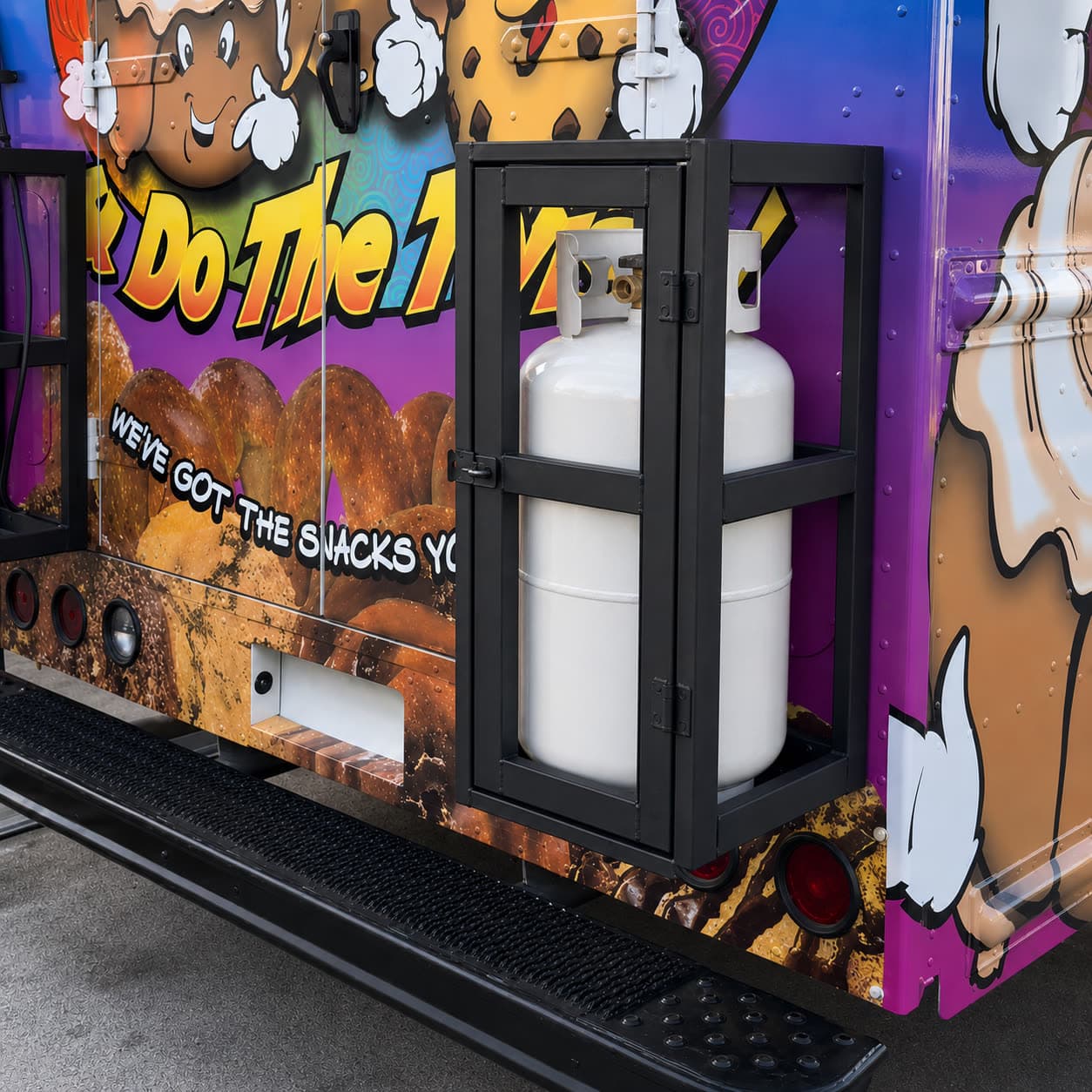
On food trucks, DOT cylinders are commonly mounted outside the vehicle inside a protective cage.
When empty, they're disconnected, transported to a refill location, and reinstalled afterward.
Typical DOT cylinder sizes include:
- 20 lb
- 30 lb
- 40 lb
- 60 lb
- 100 lb
These are the cylinders most custom propane tank cages are designed to protect.
Advantages of DOT Cylinders
Portable cylinders offer several practical benefits.
They can be:
- removed for refilling
- replaced individually
- upgraded later if your needs change
- used on trucks where permanent tanks aren't practical
They're also familiar to most propane suppliers and relatively straightforward to service.
Things to Consider
Portable cylinders also come with trade-offs.
Compared with permanently mounted tanks, they require:
- manual handling
- disconnecting and reconnecting regulators
- periodic DOT requalification
- secure exterior mounting
As cylinder size increases, handling becomes more difficult.
A full 100 lb cylinder weighs roughly 170 pounds, making safe lifting an important consideration.
What Is an ASME Tank?
ASME tanks serve the same basic purpose as DOT cylinders, but they're designed for permanent installation.
Instead of removing the tank for refilling, propane is added through an external fill connection while the tank remains mounted to the vehicle.
ASME tanks are commonly used on:
- larger food trucks
- RVs
- mobile commercial equipment
- permanently installed propane systems
Unlike removable cylinders, they're intended to stay with the vehicle throughout their service life.
Advantages of ASME Tanks
Many operators choose ASME tanks because they offer:
- onboard refilling
- fewer heavy lifts
- permanent installation
- integrated mounting brackets
For trucks that consume large amounts of propane every week, eliminating the need to remove heavy cylinders can be a significant convenience.
Things to Consider
ASME tanks aren't automatically the better choice.
They require:
- sufficient frame space
- permanent installation
- different mounting considerations
- a propane supplier capable of filling onboard tanks
For many small and mid-sized food trucks, removable DOT cylinders remain the simpler solution.
| DOT vs. ASME Comparison | ||
|---|---|---|
| Feature | DOT Cylinder | ASME Tank |
| Designed to be removed for filling | Yes | No |
| Permanently mounted | No | Yes |
| Filled on the vehicle | No | Yes |
| Common orientation | Vertical | Usually horizontal |
| Periodic DOT requalification | Yes | No DOT-style requalification |
| Common food truck use | Small to large removable systems | Larger permanent installations |
This isn't a matter of one system being better than the other.
It's about matching the propane system to the way the truck operates.
Understanding OPD Valves
One area that causes confusion is overfill prevention devices, commonly called OPD valves.
Most people recognize them by the triangular handwheel found on common grill cylinders.
According to the research, OPD valves are generally required on propane-capacity cylinders from 4 lb through 40 lb that meet the applicable requirements.
Standard 60 lb and 100 lb vertical cylinders typically use different service valve configurations instead of the familiar OPD design.
That's one reason valve layouts often look different when you move from smaller cylinders to larger commercial ones.
Requalification Requirements
Portable DOT cylinders don't last forever.
Federal regulations require them to be requalified after a certain period following manufacture, with future inspection intervals depending on the requalification method used.
The research notes:
- initial requalification is generally required within 12 years
- later inspection intervals vary depending on the approved inspection method
The manufacture date and any requalification markings are stamped into the cylinder collar.
Refilling vs. Exchange
For food truck operators, this is often an overlooked consideration.
Twenty-pound cylinders have one major advantage:
They're easy to exchange.
Exchange cabinets are available at thousands of retail locations.
Larger cylinders generally don't offer that convenience.
Thirty-, forty-, sixty-, and one-hundred-pound cylinders are usually refilled rather than exchanged.
Refilling
Advantages include:
- keeping your own cylinder
- paying only for the propane you receive
- avoiding partially filled exchange cylinders
- better suited to commercial food truck operations
- Exchange
Exchange is convenient, but the research points out an important detail:
Many exchange cylinders contain 15 lb of propane, not a full 20 lb fill.
For occasional grill use that may not matter.
For a business that depends on propane every day, refilling often provides better value and more predictable runtime.
Which System Makes Sense?
For most new food truck owners, removable DOT cylinders remain the most practical choice.
They're widely available, relatively easy to install, and compatible with the kinds of exterior propane tank cages commonly found on commercial food trucks.
ASME tanks become more attractive when:
- propane demand is consistently high
- minimizing cylinder handling is important
- the truck is designed around a permanent propane installation
Neither choice is universally correct.
The right decision depends on your equipment, operating schedule, available space, and long-term plans.
In the next section, we'll look at food truck propane regulations, inspection requirements, and the code considerations that affect where and how propane cylinders can be mounted.
6. Food Truck Propane Regulations and Inspection Requirements
One of the biggest mistakes food truck owners make is assuming there's one set of propane rules that applies everywhere.
There isn't.
Most jurisdictions base their requirements on national standards such as NFPA 58, but cities, counties, and states may adopt different editions, add local amendments, or enforce additional requirements through the local fire marshal or other authority having jurisdiction (AHJ).
For that reason, it's best to think of national codes as the starting point rather than the final answer.
Basic Requirements Found in Most Jurisdictions
Although enforcement varies, the research identified several requirements that appear consistently in NFPA 58 guidance for mobile food facilities.
Cylinders must be properly mounted
Propane cylinders cannot simply sit on the rear bumper or be held in place with straps or bungee cords.
The mounting system must securely restrain the cylinder so it cannot shift, rotate, or become loose during transportation.
NFPA guidance also requires mounting systems capable of withstanding static loading equal to four times the filled weight of the container.
Cylinders must remain outside the vehicle
Portable propane cylinders are generally required to be:
outside the occupied vehicle space, or inside a vapor-tight compartment that is vented to the exterior.
The purpose is simple.
If propane leaks, it should vent safely outside rather than collecting inside the food truck.
Because propane is heavier than air, leaked gas can accumulate in low areas if it cannot escape.
Shutoff valves must remain accessible
Inspectors need to verify that the main service valve can be reached quickly.
A propane tank cage should protect the cylinder without preventing operators from shutting the gas off when necessary.
This is another reason cage design matters.
A cage that's difficult to access may create inspection problems even if it's structurally sound.
Cylinders must be protected
Food trucks spend their lives on the road.
Road debris, weather, vibration, and accidental impacts are all part of normal operation.
National guidance requires cylinders and associated components to be protected from damage.
For many trucks, that's one of the primary reasons a properly designed exterior propane tank cage is used.
Leak Testing and Documentation
Installing the system correctly is only part of the job.
The propane system also needs to be inspected and tested regularly.
The research identifies several recurring requirements, including:
- annual system testing
- documented leak testing
- leak checks whenever cylinders are replaced
- periodic staff refresher training
Documentation requirements vary by jurisdiction, but maintaining inspection records is generally considered a best practice even when they're not specifically requested.
Replacing a Cylinder
Changing propane cylinders should be treated as a maintenance procedure rather than a routine fuel stop.
Each replacement is an opportunity to inspect:
- regulator connections
- flexible hoses
- valves
- mounting hardware
- cylinder condition
The research specifically notes that leak checks should be performed whenever cylinders are replaced.
Local Regulations Can Be Very Different
One of the most valuable findings in the research is that propane rules vary considerably between jurisdictions.
Examples include differences in:
- maximum propane capacity
- number of cylinders allowed
- permit requirements
- inspection procedures
- mounting details
Some jurisdictions regulate total propane capacity by appliance input.
Others specify maximum cylinder counts.
Others require permits once propane storage exceeds certain thresholds.
Rather than trying to memorize every local rule, the better approach is to confirm requirements with the AHJ before building or modifying the propane system.
Propane Leak Detectors
Several jurisdictions referenced in the research require propane leak detectors listed for vehicle use.
Requirements may include:
- installation of a listed detector
- regular testing
- documentation of testing
Even where not specifically required, propane leak detectors provide an additional layer of safety and are commonly found on professionally built food trucks.
Transporting Spare Cylinders
The research also highlights another point that's often misunderstood.
Disconnected propane cylinders should not be transported or stored inside the vehicle.
Spare cylinders should remain outside the occupied space and be transported according to applicable regulations.
What Inspectors Typically Look For
Although inspection procedures differ, a typical propane inspection may include:
- cylinder condition
- manufacture and requalification dates
- secure mounting
- regulator installation
- hose condition
- leak testing
- valve accessibility
- cylinder protection
- propane detector (where required)
- overall workmanship
Thinking about these items during the design phase is much easier than correcting them after the truck has already been built.
Planning Your Installation
Before purchasing a propane tank cage or fabricating mounting brackets, ask yourself:
Which cylinder size am I actually using? Have I measured the real cylinder? Is there enough clearance to remove the cylinder? Can I easily reach the shutoff valve? Is the regulator protected? Will this installation satisfy my local AHJ?
Answering those questions early usually results in a cleaner installation and fewer surprises during inspection.
The next section covers choosing a propane tank cage, measuring your truck, and designing an installation that's practical to use every day, not just one that looks good in photos.
7. Choosing a Propane Tank Cage
A propane tank cage does more than hold a cylinder in place.
A well-designed cage protects the tank during transport, helps prevent theft, keeps the cylinder properly secured, and makes routine maintenance easier. It should also allow quick access to the service valve and regulator while providing enough room to remove and replace the cylinder without fighting the enclosure.
For most food truck owners, the goal isn't to build the strongest cage possible. It's to build one that's secure, practical, and appropriate for the truck and the cylinders being used.
What a Good Propane Tank Cage Should Do
Regardless of cylinder size, every cage should accomplish several basic goals.
Keep the Cylinder Secure
Food trucks experience constant vibration.
Every bump, pothole, curb, railroad crossing, and highway mile places stress on mounted equipment.
A properly designed cage prevents the cylinder from shifting or moving during transport while allowing normal expansion and service access.
Protect the Tank
The rear of a food truck is exposed to:
- road debris
- weather
- accidental impacts
- loading equipment
- customer traffic
A steel cage provides a layer of protection that exposed cylinders simply don't have.
Allow Easy Cylinder Changes
Changing propane cylinders shouldn't require disassembling half the truck.
A practical cage allows operators to:
- unlock the door
- disconnect the regulator
- remove the cylinder
- install a replacement
- reconnect everything
- perform a leak check
without unnecessary difficulty.
If routine maintenance becomes frustrating, it usually means the installation wasn't planned with serviceability in mind.
Keep the Shutoff Valve Accessible
The research emphasizes that shutoff valves must remain accessible without tools. That means the cage should protect the cylinder without blocking the operator from reaching the service valve quickly if propane needs to be shut off.
Measuring Before Buying a Cage
One of the biggest reasons cages don't fit properly is simple:
The cylinder wasn't measured first.
Remember that manufacturer dimensions vary slightly.
Before ordering a cage, measure:
- overall cylinder height
- maximum diameter
- available mounting width
- available mounting height
- available mounting depth
Then compare those measurements to the cage's interior dimensions.
Leave Room for More Than the Tank
It's tempting to design a cage that fits the cylinder as tightly as possible.
In practice, that's rarely a good idea.
The installation also needs room for:
- the regulator
- flexible pigtail hoses
- valve operation
- removing the cylinder
- future maintenance
The research notes that collar design, foot rings, and valve configurations vary between manufacturers, so designing around body diameter alone can create problems later.
Locking the Cage
Many food truck owners choose cages with lockable doors.
A lock won't prevent every theft, but it can help discourage casual tampering and make opportunistic theft more difficult when the truck is parked overnight or stored between events.
The goal isn't to make the cylinder impossible to remove.
It's to make unauthorized access less convenient while preserving easy access for normal operation.
Standard vs. Custom Cages
For many trucks, a standard cage designed around common cylinder sizes works well.
A custom cage may make more sense when:
- mounting space is unusual
- multiple cylinders are required
- the truck has unique bodywork
- additional equipment shares the mounting area
Because cylinder dimensions vary between manufacturers, custom fabrication should always begin with measurements from the actual cylinders whenever possible.
Installing the Cage
Every truck is different, but several planning steps apply to nearly every installation.
Before drilling holes or welding brackets, verify:
- available mounting space
- cylinder size
- door swing clearance
- regulator location
- hose routing
- access for future maintenance
- local inspection requirements
Thinking through these details before installation usually prevents costly modifications later.
A Practical Installation Checklist
Before mounting a propane tank cage, confirm:
The cage matches the cylinder size being used. The actual cylinder has been measured. There is enough clearance to remove the cylinder. The service valve remains easy to reach. Regulators and hoses are protected. Mounting points are structurally appropriate. Local code requirements have been reviewed. When a Custom Cage Makes Sense
Not every truck fits a standard solution.
Custom fabrication is often worth considering when:
- you're using uncommon cylinder sizes
- multiple cylinders need to share one enclosure
- the truck has limited mounting space
- another piece of equipment occupies the same area
- you're building a truck from scratch
In those situations, designing the cage around the truck instead of trying to make an off-the-shelf cage fit often produces a cleaner, easier-to-maintain installation.
Learn More
If you're planning a new installation, these companion guides provide more detailed information:
- Food Truck Propane Tank Dimensions
- How to Measure Your Propane Tank
- Propane Tank Cage Buying Guide
- DOT vs. ASME Tanks
- Food Truck Propane Regulations
Each covers a specific part of the planning process in greater detail while this guide serves as the overall reference.
Next, we'll cover routine maintenance, leak testing, common mistakes, and a practical pre-shift propane inspection checklist that every food truck operator can use.
8. Routine Maintenance and Safety
A well-designed propane system doesn't stay safe on its own.
Hoses age. Fittings loosen. Cylinders get replaced. Trucks spend thousands of miles on rough roads.
The good news is that most problems can be caught early with a few simple inspections that become part of your regular operating routine.
Before Every Service Day
A quick visual inspection only takes a few minutes and can help identify issues before customers arrive.
Look for:
- damaged hoses
- loose fittings
- excessive rust
- impact damage
- missing hardware
- regulator damage
- signs of leaks
- anything that looks different than it did yesterday
You're not performing a complete inspection every morning.
You're simply looking for obvious problems before opening for business.
Inspect the Cylinder
Walk around the cylinder and check for:
- deep rust
- dents
- gouges
- bent foot rings
- damaged collars
- unreadable markings
Normal cosmetic wear is expected on working equipment.
Structural damage is not.
If you're unsure whether a cylinder should remain in service, have it evaluated by a qualified propane supplier.
Check the Mounting Hardware
The truck moves.
Everything mounted to it moves too.
Periodically verify that:
- bolts remain tight
- welds appear intact
- hinges operate smoothly
- the latch closes securely
- nothing has shifted since the previous inspection
Road vibration has a way of finding weak points over time.
Inspect Hoses and Regulators
Flexible hoses deserve special attention because they experience movement every time a cylinder is changed.
Look for:
- cracks
- abrasion
- cuts
- flattened sections
- damaged fittings
Also inspect the regulator.
Make sure it appears securely mounted and free from obvious damage.
If the regulator vent has become clogged with dirt or debris, clean or replace it according to the manufacturer's recommendations.
Leak Testing
Whenever a propane cylinder is replaced or the propane system has been disconnected, perform a leak check before putting the truck back into service.
The research recommends leak checks whenever cylinders are changed.
A simple leak test uses an approved leak detection solution applied to connections after the system is pressurized.
If bubbles appear, close the cylinder valve and correct the problem before operating the system.
Don't Ignore the Smell of Propane
Commercial propane contains an odorant added specifically to help people recognize leaks.
If you smell propane:
Shut off the propane supply if it is safe to do so. Stop using propane appliances. Move people away from the area. Identify and correct the problem before returning the system to service.
Never ignore a persistent propane odor.
Propane Storage Between Events
If your truck will be stored for an extended period:
- close the cylinder valves
- secure the propane tank cage
- inspect hoses before the next use
- protect regulators from unnecessary weather exposure
Good storage habits reduce maintenance problems when the truck goes back into service.
Common Mistakes
Many installation problems aren't caused by complicated engineering issues.
They're caused by simple planning mistakes.
Assuming Every Tank Is the Same Size
A "40 lb cylinder" isn't one universal product.
Different manufacturers produce slightly different dimensions.
Always measure your actual cylinder before ordering a cage.
Choosing a Cage That Barely Fits
A cage should accommodate more than the cylinder body.
Remember to leave room for:
- regulators
- valves
- hose routing
- maintenance access
A little extra clearance usually makes future service much easier.
Choosing Tank Size Based Only on Runtime
Runtime matters.
But it's only one part of the decision.
Also consider:
- weight
- available mounting space
- refill convenience
- local regulations
- appliance demand
The best propane system is the one that balances all of those factors.
Ignoring Manufacturer Differences
The research found noticeable differences in:
- height
- diameter
- empty weight
- collar design
- valve configuration
especially among 60 lb and 100 lb cylinders.
Forgetting Local Requirements
National codes provide a foundation.
Local jurisdictions may adopt additional requirements.
Before modifying your truck, confirm requirements with the local AHJ instead of relying solely on online information.
Food Truck Propane Pre-Shift Checklist
Print this checklist and keep it with your daily opening procedures.
Cylinder
- No visible damage
- No excessive rust
- Current inspection markings visible
Mounting
- Cage secure
- Mounting hardware tight
- Cylinder properly restrained
Propane System
- Regulator appears undamaged
- Hoses free from abrasion
- Service valve accessible
Before Opening
Leak check completed after cylinder replacement No propane odor detected Area around cylinders clear Frequently Asked Questions What size propane tank is best for a food truck?
There's no universal answer.
The best size depends on your available space, total appliance BTU demand, desired runtime, and local requirements.
Many supplier resources identify 40 lb cylinders as a practical balance for standard food trucks, while higher-demand operations often use 60 lb or 100 lb cylinders.
How long does a 100 lb propane tank last?
That depends entirely on appliance demand.
A truck operating one appliance will run much longer than a truck running several high-BTU appliances simultaneously.
The runtime table earlier in this guide provides representative examples based on continuous appliance operation.
Are all 100 lb propane tanks the same size?
No.
Manufacturers produce slightly different dimensions, valve arrangements, and collar designs.
Always measure the actual cylinder before purchasing a propane tank cage.
Can I use a horizontal propane cylinder?
Only if it was designed and approved for that orientation.
Standard vertical DOT cylinders should remain vertical during operation.
Permanent horizontal ASME tanks are specifically designed for horizontal installation.
Should I refill or exchange my propane cylinders?
Twenty-pound cylinders are commonly exchanged.
Larger commercial cylinders are generally refilled.
For many food truck operators, refilling provides better value and keeps the same cylinder matched to the existing mounting system.
Do I need a propane tank cage?
Many food trucks use exterior propane tank cages to help secure and protect removable DOT cylinders.
A properly designed cage helps protect the cylinder, allows service access, and supports a clean, professional installation.
Choose a cage that matches the cylinder being used, and always measure before ordering.
Related Guides
Continue learning with these companion articles:
- Food Truck Propane Tank Dimensions
- How to Measure Your Propane Tank
- Propane Runtime Calculator
- DOT vs. ASME Tanks
- Food Truck Propane Regulations
- Propane Tank Cage Buying Guide
- Food Truck Propane Installation Guide
- Final Thoughts
Choosing a propane tank for a food truck isn't simply a matter of buying the largest cylinder that fits.
The best propane system balances fuel capacity, appliance demand, available space, maintenance, and local code requirements. It should also be easy to inspect, easy to service, and built around the way the truck is actually used.
Whether you're building a new food truck or upgrading an existing one, start by understanding your propane demand, measure the cylinders you plan to use, and verify local requirements before purchasing equipment.
If your truck uses removable DOT cylinders, selecting the right propane tank cage is part of that planning process. A properly sized cage helps protect the cylinders while maintaining the accessibility and serviceability needed for everyday commercial operation.